Planning asbestos removal is an important step when renovating, repairing or preparing an older property for other building work. Before requesting a price, it helps to gather clear information about the material, its location, the property’s access and the work you intend to complete. The more useful information you can provide, the easier it is for a removal contractor to understand the job and identify what needs to be clarified.
If you are looking for an accurate asbestos removal quote, remember that the price is not determined by the material alone. The amount to be removed, its condition, access restrictions, site arrangements and the nature of the project can all affect the scope of work.
This checklist is designed for Melbourne homeowners, renovators, builders and property managers who want to prepare for a quote without disturbing suspected asbestos-containing material.
Why good preparation matters when requesting an accurate asbestos removal quote
A quote needs to reflect the actual work required, not just a rough description such as “remove some asbestos”. Two properties may contain similar-looking cement sheet materials but have very different removal requirements because of their location, condition, quantity and accessibility.
For example, an external wall lining that can be accessed from ground level may present different site considerations from a cement-sheet lining in a narrow side passage or an elevated area. A renovation may also require coordination with other trades, restricted access times or a particular work sequence.
Providing useful information at the beginning can help reduce avoidable back-and-forth communication. It can also help the contractor identify whether further information or an on-site assessment is needed before the scope and price can be confirmed.
A clear asbestos removal quote information package should explain what you believe needs attention, where it is located and what is happening at the property. It should not involve you touching, drilling, cutting or breaking the material to obtain better details.
1. Identify the property and provide the basic site details
Start with the property’s address and a reliable contact person. Include whether the property is residential, commercial or industrial, and whether it is occupied.
These asbestos removal site details help the contractor understand the general setting and discuss practical arrangements. For example, an occupied home may need different access coordination from a vacant property undergoing renovation.
Useful information includes:
- Full property address and suburb.
- Property type and whether it is occupied.
- Name and contact details of the person coordinating the work.
- Whether the enquiry is being made by the owner, builder, property manager or another authorised representative.
- Any known access restrictions, security arrangements or site-specific requirements.
- Suitable times for a discussion or site visit, if required.
If the property is part of a larger building or commercial site, identify the relevant building, tenancy, level or work area. This can prevent confusion when more than one location or material is involved.
For a Melbourne enquiry, include the suburb rather than only writing “Melbourne”. A request for an asbestos removal quote Melbourne contractor can be easier to assess when the actual site location and access arrangements are clear.
2. Describe the suspected material without disturbing it
The next step is to describe what you believe may contain asbestos. You might have concerns about an older cement-sheet wall, eaves, fence, outbuilding, garage lining or another building component.
However, appearance and age alone cannot confirm that a material contains asbestos. Some products can look similar, and a photograph is not a laboratory identification result.
If you already have reliable documentation, such as an existing asbestos register, survey report or previous material assessment, mention it when making the enquiry. Provide the relevant information through an appropriate, safe method.
If you do not have confirmation, describe the material as suspected asbestos rather than stating that it is definitely asbestos-containing.
Useful details may include:
- The building component or area where the material is located.
- Whether it is internal or external.
- Whether it appears to be cement sheet or another type of product.
- Whether there are existing records identifying the material.
- Whether it is intact, visibly damaged or deteriorating.
- Whether planned work may disturb it.
Do not take a sample yourself, scrape a surface, remove a corner or break a piece to show the contractor. If identification is uncertain, ask what professional assessment is appropriate before removal is planned.
This distinction matters because the material’s confirmed type and condition can affect the work method, safety controls and contractor requirements.
3. Explain the location and approximate quantity
A useful quote request should identify where the material is and how much may be involved. You do not need to put yourself at risk to obtain exact measurements. An approximate description based on existing plans or measurements already available may be enough for an initial discussion.
For example, explain whether the suspected material is on one wall, around the eaves, along a fence line, inside a garage or in a separate outbuilding. If there are several areas, list them separately rather than combining everything into one estimate.
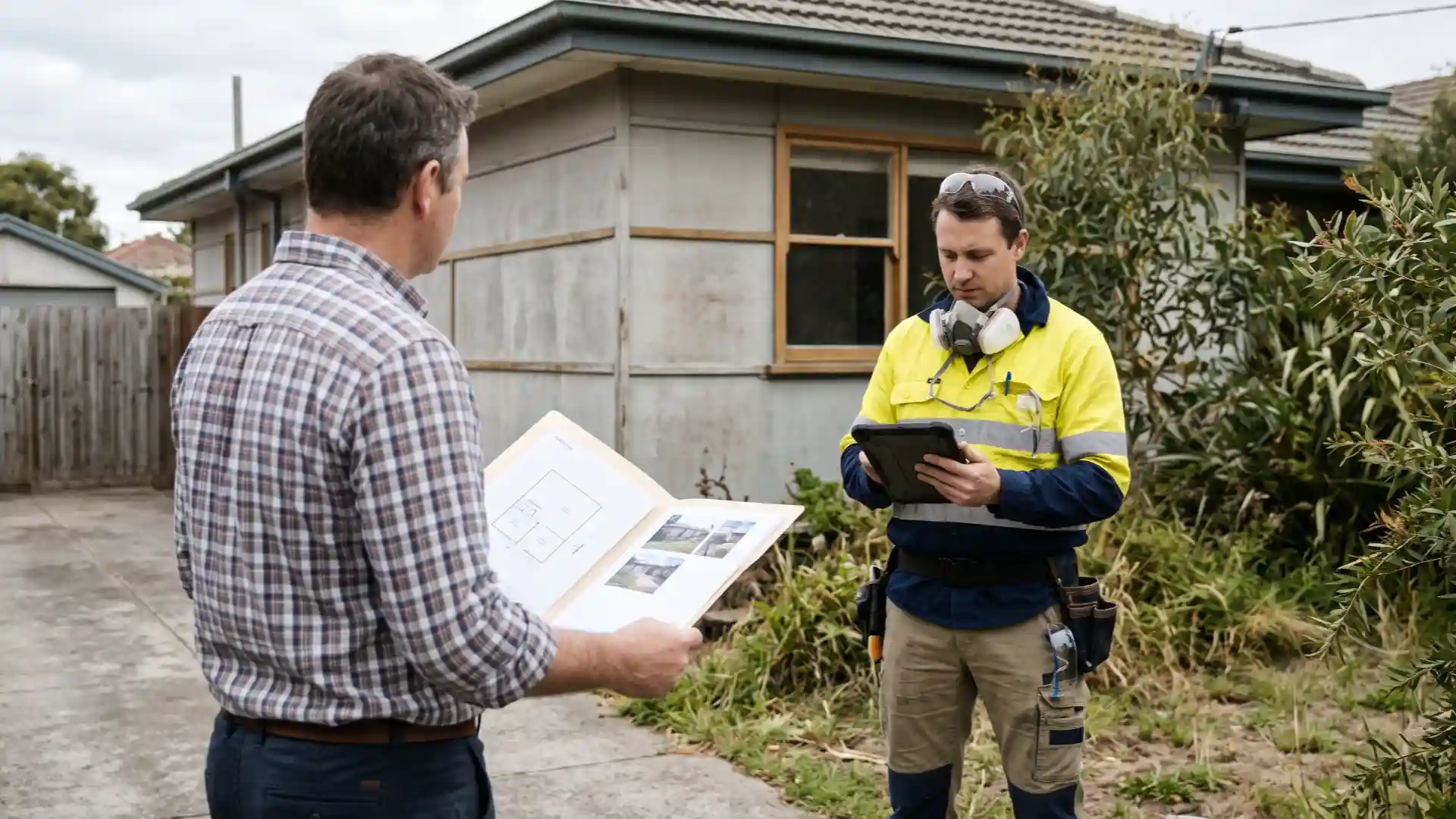
Where safe and practical, existing building plans or renovation drawings may help explain the area. You can also describe the approximate length, height or number of sections if those details are already known.
These asbestos removal measurements are preliminary information only. They do not confirm the material type or establish the final removal scope. A contractor may need to inspect the site or clarify the measurements before confirming the work and price.
Try to answer these questions:
- Is the material in one location or several?
- Is it attached to a wall, ceiling, roof edge, fence or another structure?
- Is the affected area easy to reach?
- Are there multiple layers or adjoining building components that may be involved?
- Does the renovation plan identify the area to be removed?
Avoid climbing ladders, entering restricted spaces or moving building components to measure suspected asbestos. Safety comes before obtaining a more detailed quote.
4. Provide photographs only when they can be taken safely
Photographs can help explain the property’s layout and the location of suspected material. They may support an initial conversation, particularly when the contractor cannot immediately visit the site.
If you already have suitable photographs, provide images taken from a safe position without touching or disturbing the material. A wider image showing the general area may be more useful than a close-up that requires approaching a damaged surface.
Good asbestos removal photos for quote purposes may show:
- The overall building or relevant room.
- The general location of the suspected material.
- The surrounding access route.
- Nearby obstacles or structures.
- The work area in relation to other renovation activities.
Do not move objects, remove coverings, open wall cavities or handle damaged material just to take a photograph. If the material is deteriorating or there is visible debris, keep people away and seek appropriate professional advice.
Photographs are supporting information, not proof that asbestos is present or absent. They also cannot always show the full extent of a material or the conditions behind it. A contractor may therefore need additional details or an on-site assessment before providing a firm scope.
5. Explain the condition of the material
Condition is an important part of the information a contractor needs. Tell them whether the material appears intact, cracked, broken, weathered or deteriorating, based on what you can observe without approaching or touching it.
Do not attempt to repair, seal, sweep, vacuum or remove damaged suspected asbestos yourself. Avoid activities that could release dust or fibres. Keep people away from the affected area and obtain suitable professional guidance.
It is also useful to mention whether the material has been affected by recent building work, water damage, impact or other events. Do not assume that a material is safe simply because it looks intact, or that a damaged material can be handled as ordinary building waste.
The distinction between bonded (non-friable) and friable asbestos is particularly important when assessing a removal enquiry. According to WorkSafe Victoria’s guidance on friable and non-friable asbestos, non-friable asbestos generally has fibres bound within a solid material, while friable asbestos can be crumbled, pulverised or reduced to powder by hand pressure when dry. Non-friable material can also deteriorate and become friable, so its condition must be considered carefully.
JD’s service scope is focused on suitable non-friable asbestos removal. If the material is friable, or its condition and type are uncertain, the job must be assessed by an appropriately qualified professional. Do not assume that every older cement-looking product is suitable for the same removal service.
6. Explain your renovation or building plans
A quote request should describe why the removal is being considered and what work is planned afterwards. The timing and sequence can affect access, coordination and the practical scope of the job.
For example, you may be preparing to:
- Renovate a kitchen, bathroom or laundry.
- Replace an external wall or building component.
- Repair or alter an older garage or outbuilding.
- Upgrade an area before other trades begin.
- Prepare a property for a larger refurbishment.
- Carry out planned maintenance or building improvements.
Include any relevant drawings, work schedules or builder instructions that are already available. If another contractor is coordinating the renovation, provide their contact details with permission so the work sequence can be discussed.
If the removal needs to happen before a particular trade starts, explain the proposed dates. Avoid assuming that a contractor can attend immediately or that a quote confirms a booking.
A well-prepared accurate asbestos removal quote request should make the project context clear. This allows the contractor to consider whether the proposed work is suitable for the service offered and what additional information may be required.
7. Explain access restrictions and site conditions
Access can have a meaningful effect on the work involved. A material may be relatively straightforward to reach at one property but difficult to access at another.
Tell the contractor about any conditions that could affect access, including:
- Narrow side passages or limited entry points.
- Stairs, slopes or uneven ground.
- Fences, gates or locked areas.
- Nearby vehicles, stored items or other obstructions.
- Occupied rooms or shared building areas.
- Restricted work hours or building management rules.
- Parking or loading limitations.
- Other trades working in the same area.
Do not remove barriers or shift heavy objects containing or covering suspected asbestos to make the site easier to inspect. Instead, explain the restriction and ask how it should be managed.
For commercial or multi-unit properties, mention any induction process, permits, tenant coordination or site contact requirements that you already know about. These details can help the contractor understand the practical arrangements before work is considered.
8. Understand what affects an asbestos removal cost estimate
There is no reliable one-price-fits-all figure for asbestos removal. The final amount depends on the specific job and the work that can safely and lawfully be undertaken.
Common asbestos removal pricing considerations include:
Material type and condition: The confirmed material type and its condition influence the removal requirements. Friable asbestos is not the same scope as suitable non-friable material.
Quantity and location: The size of the affected area and the number of separate locations can change the time and resources required.
Access: Restricted entry, height, obstacles and site layout may affect how the work is planned.
Site preparation and controls: Appropriate work-area controls, protection, equipment and other safety measures form part of the removal scope.
Project coordination: Occupied properties, other trades, building management requirements and timing restrictions may need to be considered.
Waste arrangements: Asbestos waste must be managed and disposed of lawfully. Where JD undertakes removal, any disposal discussion should relate to waste generated through that removal work—not a separate general waste collection service.
These factors help explain why an asbestos removal cost estimate based on a short message may change once the material and site conditions are properly understood. Ask the contractor to explain what is included in the proposed scope and what assumptions have been made.
What about asbestos clean up cost?
People sometimes search for asbestos clean up cost when they have found suspected debris or damaged material. It is important to explain exactly what has happened rather than treating every clean-up enquiry as a standard removal job.
The presence of loose debris, suspected contamination or damaged material may require a different assessment from the planned removal of intact non-friable building material. Do not sweep, vacuum, bag or move suspected asbestos debris yourself.
JD’s stated scope should not be confused with standalone asbestos waste collection or an unrestricted contamination clean-up service. If the enquiry involves material or waste not generated through JD’s own removal work, clarify the requirement before assuming it falls within the service.
9. Ask what the quote includes
A quote should make the proposed scope understandable. If something is unclear, ask for clarification before agreeing to the work.
Depending on the job, useful points to confirm include:
- The material and area included in the proposed work.
- Any assumptions about the material type or quantity.
- The work activities covered by the price.
- Site access and preparation requirements.
- How the work area will be controlled.
- How waste generated through the removal work will be managed.
- Any exclusions or work that is not included.
- Whether further assessment is needed before the scope can be confirmed.
- Any timing assumptions or conditions affecting the proposed schedule.
Do not compare quotes by looking at the final number alone. One quote may cover a different area, include different site arrangements or be based on assumptions that another quote does not share.
If two prices are substantially different, ask both contractors to explain the scope and exclusions. A lower price is not necessarily better if important work or controls have been left out.
10. Are small asbestos removal jobs quoted differently?
Some customers assume that a small amount of material will automatically mean a simple or inexpensive job. That is not always the case. Even small asbestos removal jobs can involve access restrictions, site preparation, safety controls and disposal arrangements.
The quantity is only one part of the assessment. The material type, condition, location and surrounding environment still matter.
Small jobs should not be treated as permission to remove suspected asbestos without checking the applicable requirements. Victoria has limited circumstances in which certain unlicensed removal of non-friable asbestos may be permitted, but strict conditions apply. The amount, time involved and other controls matter; a small-looking job is not automatically exempt.
For work that requires a licensed removalist, the relevant licence class and legal requirements must be followed. If you are unsure, seek advice rather than relying on a rough area estimate.
When requesting a quote for a small job, provide the same core information as you would for a larger project. Explain the location, suspected material, condition, access and reason for removal. This gives the contractor a better basis for considering whether the job is within the service scope.
11. A simple checklist before you send your enquiry
Before contacting a contractor, use this checklist to organise the information you already have.
- Property address and Melbourne suburb.
- Property type and whether it is occupied.
- Contact person and preferred contact method.
- Location of the suspected asbestos-containing material.
- Description of the building component or product.
- Any existing asbestos register, survey or relevant records.
- Approximate area or quantity, if already known.
- General condition observed from a safe distance.
- Existing photographs taken without disturbing the material.
- Access restrictions and site conditions.
- Renovation, repair or demolition plans.
- Proposed timing and coordination requirements.
- Any known building management or site access rules.
You do not need to have every answer before making an enquiry. If something is unknown, say so. It is better to identify missing information honestly than to guess about asbestos type, quantity or condition.
12. Requesting a quote from JD Asbestos Removal
Once you have gathered the available information, you can submit an enquiry through the JD Asbestos Removal quote request page.
Include the property location, a description of the suspected material, where it is situated and what renovation or building work is planned. If you have relevant existing records or safe photographs, mention that information as well.
JD is based in Dandenong and focuses on suitable non-friable asbestos removal for residential, commercial and industrial projects across Melbourne and selected areas of Victoria. The suitability of a job depends on the material, site conditions and the work required.
If your enquiry involves friable asbestos, standalone testing or inspection, or collection of asbestos waste from another contractor’s work, do not assume that it is included in JD’s removal service. Clarify the requirement and seek the appropriate specialist where necessary.
A clear enquiry helps establish whether the proposed work fits the service scope and what further information may be needed to assess it. It does not automatically confirm a final price, a booking or an attendance time.
Final preparation: make your quote request clearer
The best way to prepare for an asbestos removal enquiry is to be organised, accurate and cautious. Provide the property details, explain where the suspected material is located, describe its visible condition from a safe distance and outline the renovation or building work planned.
Do not disturb suspected asbestos to obtain measurements or photographs. Use existing records where available, and explain honestly when the material type or quantity has not been confirmed.
A clear accurate asbestos removal quote request gives the contractor a more useful starting point. It can help identify missing information, clarify the proposed scope and make it easier to discuss the next steps.
If you are planning suitable non-friable asbestos removal in Melbourne, prepare the details you already have and contact JD Asbestos Removal through its quote enquiry page.
Frequently Asked Questions
-
What information should I provide when requesting an asbestos removal quote?
Provide the property address, type of property, location and description of the suspected material, its visible condition, approximate quantity if already known, site access details and the reason for removal. Existing asbestos records and safely obtained photographs may also help. Do not disturb suspected asbestos to collect information.
-
Can I get an asbestos removal quote using photographs?
Photographs may help a contractor understand the general location and surrounding site conditions during an initial enquiry. However, photographs cannot confirm whether a material contains asbestos or always establish the full removal scope. Further information or an on-site assessment may be required.
-
What factors affect the cost of asbestos removal?
The cost can depend on the confirmed material type and condition, quantity, location, access, site preparation, safety controls, project coordination and waste arrangements. A quote should explain the work included and any assumptions or exclusions.
-
Does JD Asbestos Removal handle small asbestos removal jobs in Melbourne?
JD focuses on suitable non-friable asbestos removal for residential, commercial and industrial projects across Melbourne and selected areas of Victoria. Whether a small job is suitable depends on the material, site conditions and work required. Contact JD with the available project details to discuss the scope.
-
Can I measure or collect a sample of suspected asbestos before requesting a quote?
Do not cut, drill, break, scrape or collect samples from suspected asbestos yourself. Use existing plans or records where available and provide approximate information only if it can be obtained safely. If the material needs identification, seek appropriate professional advice.
Leave a Reply